

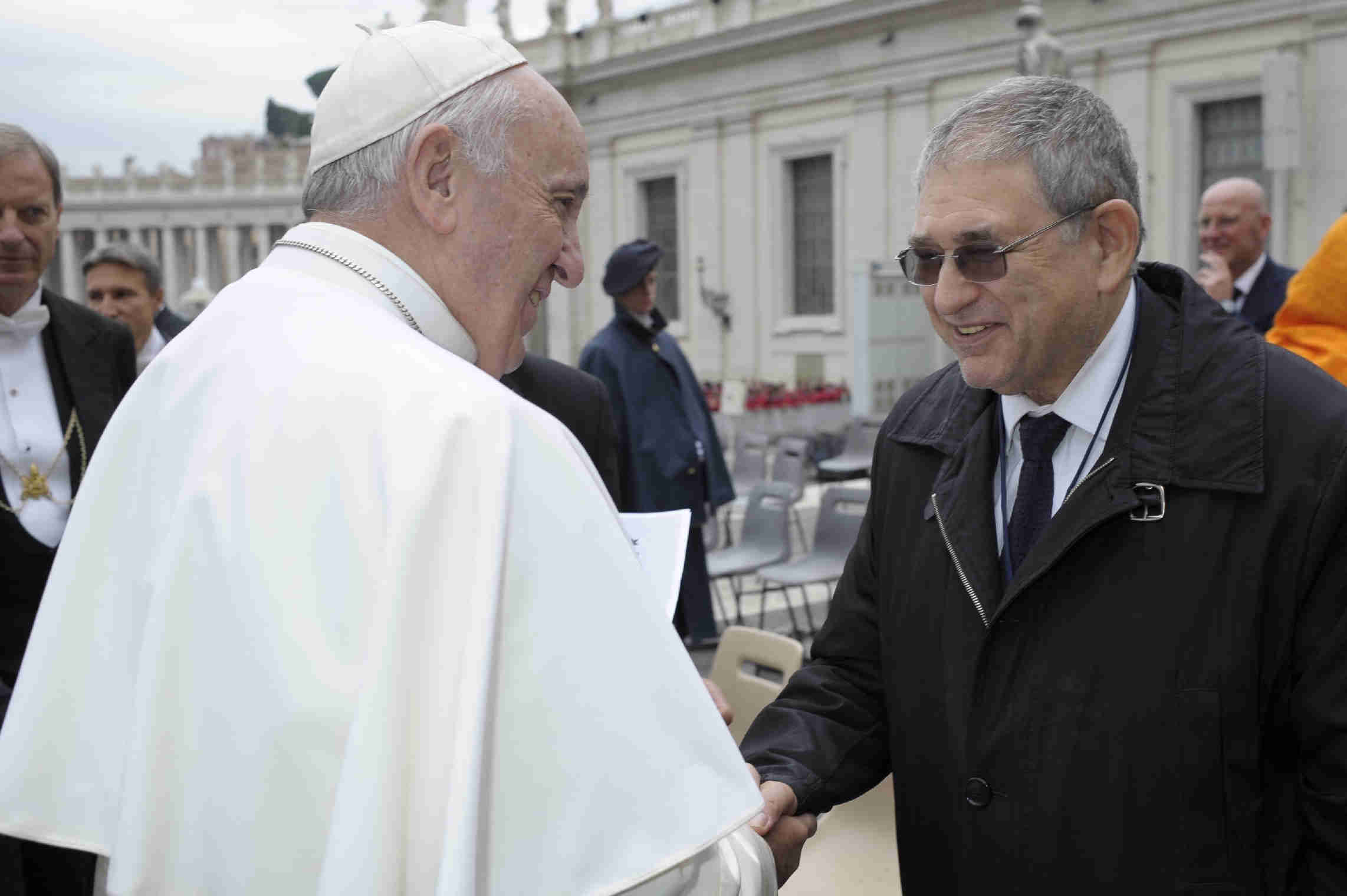

A report by Shimon Samuels and Alex Uberti
Paris, 5 February 2026
As Director for International Relations of the Simon Wiesenthal Center, Dr. Shimon Samuels has denounced the ID theft of Jewish and Christian heritage for 15 years... at the World Heritage Committee sessions in Mumbai, Riyadh, Manama, Cracow, Doha, Bonn, Phnom Penh, St. Petersburg or Paris. We are now, in 2026, confronted with a new frenzy of “heritage grabbing”.
As reported by Palestinian and Arab press agencies - including Al-Jazeera - the Palestinian Ministry of Tourism and Antiquities submitted to the United Nations Educational, Scientific and Cultural Organization (UNESCO) a "list of 14 heritage sites" (that de facto include a much larger number of individual sites). Most of these belong to Jewish or Christian heritage in the Holy Land, and are not Arab-Muslim or “Palestinian”.
Among the claimed sites, the “Canaanite city-States”, also known as the “Philistine pentapolis” (5 cities) of Ashkelon, Ashdod, Ekron, Gath, and Gaza.
Historical traces of these cities are found in the Biblical descriptions by Hebrew prophets Joshua and Samuel. The Baal-worshipping Philistines originally immigrated from the Greek-Aegean area, gained a foothold in the southern levant commercial routes, were defeated on several occasions, finally exiled to Babylonia, and were extinct by the 5th century BCE.
The only one site that has ever resided in Palestinian-controlled territory is Gaza, since 2006. The other archaeological sites are all within the borders of the State of Israel. Ashkelon is a city along the coast about 18 km north of the Gaza strip, while Ashdod, Israel’s largest port, is a further 20 km away. Ekron and Gath are archaeological sites inland and about 30 km east of Ashdod.
The Palestinian claim is therefore on heritage sites that are integral to the State of Israel.
Another claim is on “Jabal al-Fureidis / Herodium”, a fortified hill built by Herod the Great, king of Judaea, in the 1st century BCE. The complex stands approximately 12 km south of Jerusalem.
The site - which Flavius Josephus described as “an acropolis dominating a city second to none” - included an ancient palace, with a bath-house, a synagogue, a theatre, a pool with an aqueduct terminal and cisterns. Herod’s burial chamber and sarcophagus were also discovered there and secured in 2007 by Israeli archaeologists.
Herodium was also a Jewish stronghold of the first Judeo-Roman war (66–73 CE), as well as during the Bar-Kokhba revolt of 132 CE. Therefore, its heritage is exclusively linked to Jewish and Israeli history.
The same goes for what the Palestinian Ministry of Tourism and Antiquities calls “Archaeological Palaces of Tulul Abu el-‘Alayiq”, i.e. what is commonly known as “the Hasmonean and Herodian royal winter palaces”, overlooking the city of Jericho. The palaces include bath-houses and ornamental gardens, an aqueduct as well as one of the most ancient synagogues ever to be discovered.
As with the Herodium, also this site is subject to the jurisdiction of the Israeli Civil Administration, and is under the protection of the Israel Nature and Parks Authority and, inevitably, a small IDF garrison. Both claimed sites have no connection whatsoever to Palestinian or even Arab history and heritage.
Furthermore, there is the plausible fear that the eventual Palestinian takeover of any Jewish or Christian heritage site would result in its destruction.
In fact, as a precedent (in 1999), the Waqf (Islamic charitable endowment) of the Al-Aqsa Mosque in Jerusalem, deliberately removed 9,000 tons of historical layers from beneath the Temple Mount, to be dumped in the Kidron Valley. Today, Israeli and international archaeologists based on Mount Scopus are recovering and sifting through the debris. They have found numerous artefacts and fragments dating back to 3,000 years ago, related to both the First and the Second Temple period.
The Palestinian objective was to erase any archaeological proof of Jewish connection to its most relevant Holy Site.
Another egregious form of erasure is purely semantic, as in the case of “Jerusalem water system Qanat es-Sabeel”... where the reference to “Solomon’s Pools” is wantonly omitted.
Even the reference to “the Wadi Kharitoun prehistoric caves” is a move against Jewish and Christian heritage, as the only historical references to this site are the ancient Judaean town of Tekoa, and the presence of Christian hermits, in particular Saint Chariton and Saint Euthymius.
More recently, in May 2001, two Israeli teenagers, Koby Mandell (13) and Yosef Ishran (14) were brutally kidnapped, tortured and murdered on that site by Palestinian terrorists. USA Today reported they had been "bound, stabbed and beaten to death with rocks.... The walls of the cave in the Judaean Desert were covered with the boys' blood”.
Yet one more matter of concern is the claim on the “Monasteries of the Jerusalem wilderness (El-Bariyah)”, an area wedged between Jerusalem, Herodium and Wadi Kharitoun. This area holds several ancient Christian monasteries, owned and preserved by the Churches. If these sites were to fall in the hands of the Palestinian authorities, there are no guarantees of safeguarding and preserving them.
In fact, the 1948 Israeli Declaration of Independence establishes that the Jewish State “will ensure complete equality of social and political rights to all its inhabitants irrespective of religion, race or sex; it will guarantee freedom of religion, conscience, language, education and culture; it will safeguard the Holy Places of all religions...”
This is in stark contrast to the absence of similar guarantees by the Fatah-led Palestinian Authority, that includes Sharia law as a fundamental source, without even mentioning Hamas’ declared intention to create an Islamic State, its genocidal intent to murder or enslave the Jews, and destroy any reference to other religious traditions.
Furthermore, while there are about 200,000 Christians of all denominations in Israel - a 400% rise since the 1950s - in Palestinian-controlled territories, remaining Christians are less than 45,000. Towns such as Bethlehem have seen their Christian population plummet from 86% in 1950, to barely 10% today.
In this context, the claim to “The Holy Miracles of Jesus Christ in Palestine” is yet another form of appropriation, more subtle but still culturally insulting. Jesus professed in the Galilee, Samaria and Judaea, a full century before the Romans renamed these territories “Palestine” (to humiliate the Jews after the Bar-Kokhba revolt).
But this also reminds us of the recurrent attempt to “Palestinize” Jesus, who was born a Jew from Jewish parents and ancestry, was recognized as a Rabbi by his contemporaries, and died as a Jew at the hands of the Romans, according to the New Testament and other historical references.
The Palestinian Ministry of Tourism and Antiquities has been bent on erasing Jewish and Christian identity and history over the past years, since the accession of the “State of Palestine” among the UNESCO World Heritage Committee members.
We hope that WHC Member States and UNESCO’s leadership will see through this Palestinian “rush-to-grab” initiative and stop it in its tracks. Otherwise, in a dramatic twist of events, this UN agency would be manipulated into striking an infamous and existential blow against Education, Science and Culture!
____________________________________________________________
Dr. Shimon Samuels is former Director for International Relations of the Simon Wiesenthal Center
Alex Uberti is Project Manager for CSW-Europe